Culture Amp and 15Five solve different review problems. Culture Amp’s Individual Effectiveness 360 is the stronger starting point when the primary job is development: its support material describes self, manager, co-worker, and direct-report perspectives and explicitly frames the workflow around growth rather than performance evaluation. 15Five is the more natural fit when a team wants formal reviews to sit alongside recurring check-ins, goals, calibration, and talent-review routines.
The important Culture Amp caveat is packaging. Culture Amp’s Perform page uses broad 360 and effectiveness language, but the current service-plan matrix lists Perform and Effectiveness separately. Do not assume that a Perform subscription includes Individual Effectiveness 360; ask for the exact module and contract terms in the proposal. Neither product page, by itself, proves that a workflow will be anonymous, easy to implement, or adopted by managers.
At a glance: Culture Amp vs 15Five
The table below compares the six lenses used throughout Best 360 Tools. “Confirmed” means the cited vendor material describes the workflow; it does not mean the experience or outcome has been independently tested. Where a detail could change the buying decision, the row stays qualified or requires a demo check.
Dimension
Culture Amp
15Five
Cycle design
Individual Effectiveness 360 documents self, manager, co-worker, and direct-report perspectives; verify the selected package and cycle settings.
Best-Self Review supports configurable self, manager, peer, and upward combinations.
Trust and visibility
Confidentiality is qualified: a small reviewer group or specific example can make a contributor identifiable.
Results are not automatically shared at cycle end, and the cited feature context covers nomination and identity settings; verify the exact policy by reviewer group.
Feedback quality
Development and growth are the stated purpose of Effectiveness 360, rather than performance evaluation.
Review cycles connect ratings and reporting with prior check-ins, goals, calibration, and Talent Matrix workflows.
Manager follow-through
Best suited to a development conversation, with the post-report coaching process to be designed and verified.
The documented suite connects reviews to check-ins, goals, calibration, and talent review.
Operating fit
Perform is marketed around reviews, calibration, goals, and development, but implementation scope and Effectiveness access need confirmation.
The review feature is presented within a wider manager-routine and talent workflow; verify integrations, rollout support, and administrator effort.
Commercial clarity
Effectiveness and Perform are separate entries in the plan matrix; 360 inclusion and contract period are verify.
Performance Reviews require the Perform or Total Platform package; current price and contract terms are verify.
How the 360 workflow differs
Culture Amp: development-first Effectiveness 360
The Culture Amp support FAQ describes Individual Effectiveness 360 as a development and growth workflow, not a performance-evaluation workflow. It documents feedback from the employee, manager, co-workers, and direct reports, with employee-driven or coach/admin-supported launch options and grouped feedback. That makes it a compelling fit for a structured development conversation where the review purpose needs to be kept separate from compensation or appraisal.
The trust boundary matters. The same FAQ qualifies confidentiality: a small reviewer group or a specific example can make a contributor identifiable. Treat that as a design constraint, not as a promise of anonymous-by-default feedback. Ask which roles can see raw comments, how small groups are handled, and what a manager or administrator can export.
Culture Amp’s package boundary is equally material. Its Perform page markets continuous feedback, performance reviews, calibration, goals, and development, while the service-plan matrix lists Perform and Effectiveness as separate products. The public material therefore supports the existence of the Effectiveness 360 workflow, but not the assumption that every Perform customer receives it. The current module, contract period, and included services belong in the proposal and contract review.
15Five: formal reviews attached to manager routines
15Five’s Best-Self Review overview documents configurable self, manager, peer, and upward review combinations. It also places Performance Reviews alongside lifecycle reviews, calibration, Talent Matrix, goals, and reporting, with connections to earlier check-ins and reviews. That is a useful model for teams that want a formal review to be one event in a recurring manager cadence rather than a separate annual survey.
The sharing step deserves a deliberate test. The feature overview says results are not automatically shared when a cycle ends, and its supporting settings cover nomination approval, peer and upward identity visibility, and who may remove answers before sharing. Those controls can support a staged review process, but they do not answer every question about anonymity, free-text exposure, or exports. Configure a cycle with the exact reviewer groups and make the vendor show what each person sees before and after sharing.
Category verdicts
There is no universal winner. The category decision depends on the job the review must do and on whether the package and visibility rules survive your policy review.
Best for development-focused 360: Culture Amp
Culture Amp is the stronger fit when the review’s primary job is development and growth, with multiple feedback perspectives. Confirm that Effectiveness 360 is included in the proposed subscription.
Best for manager routines and coaching cadence: 15Five
15Five is the stronger fit when formal cycles need to connect to check-ins, goals, calibration, and talent review. Validate manager adoption with a real cycle.
Trust and result-sharing governance: neither by default
Culture Amp qualifies confidentiality, while 15Five documents staged sharing and identity settings without establishing every anonymity rule. Test raw comments, small groups, and exports.
Commercial clarity for a mixed suite: verify both proposals
Culture Amp’s Effectiveness/Perform boundary and 15Five’s Perform/Total requirement both make module scope important. Neither is a commercial winner until the proposal is specific.
Buyer profiles
Growing companies
Choose 15Five when the immediate operating problem is creating a repeatable manager rhythm around check-ins and formal reviews, and choose Culture Amp when the immediate problem is running a focused development 360. A smaller team should not buy either on feature breadth alone: ask who will configure the cycle, what happens when a reviewer group is small, and whether the proposed package adds administrative overhead.
Mid-market teams
Mid-market HR teams often need both a credible feedback process and enough governance to explain result visibility. Culture Amp’s development boundary can be useful when 360 is intentionally separate from appraisal; 15Five’s connected check-ins, goals, calibration, and talent-review surfaces can be useful when managers already operate in that cadence. Compare those workflow choices against the current service plan, seat scope, implementation support, and data policy rather than treating either product’s package as implied.
Enterprise organizations
For an enterprise rollout, make the decision a governance and operating-model review. Culture Amp may fit a development-led 360 program, while 15Five may fit an established manager-review system that needs connected check-ins and calibration. The cited public records do not establish implementation scale, integrations, data residency, support levels, or contract concessions, so enterprise buyers should keep those points explicitly verify until they are demonstrated and written into the proposal.
Questions to ask in a demo
In Culture Amp, is Individual Effectiveness 360 included in the proposed Perform plan, a combined plan, or a separate contract? Show the current plan document and renewal terms.
In 15Five, which package unlocks the exact Best-Self Review, calibration, Talent Matrix, reporting, and integrations in scope?
Configure one cycle with self, manager, peers, and a direct report. Who nominates, approves, removes, and finally sees each response?
Show what happens when a reviewer group is small or a comment contains a uniquely identifying example. Is the response grouped, redacted, withheld, or visible to an administrator?
End the cycle without sharing results. What can the manager edit or remove, what does the employee see, and what can be exported?
Change a reporting line or miss a deadline mid-cycle. Which reminders, approvals, and audit details persist?
Other options to consider
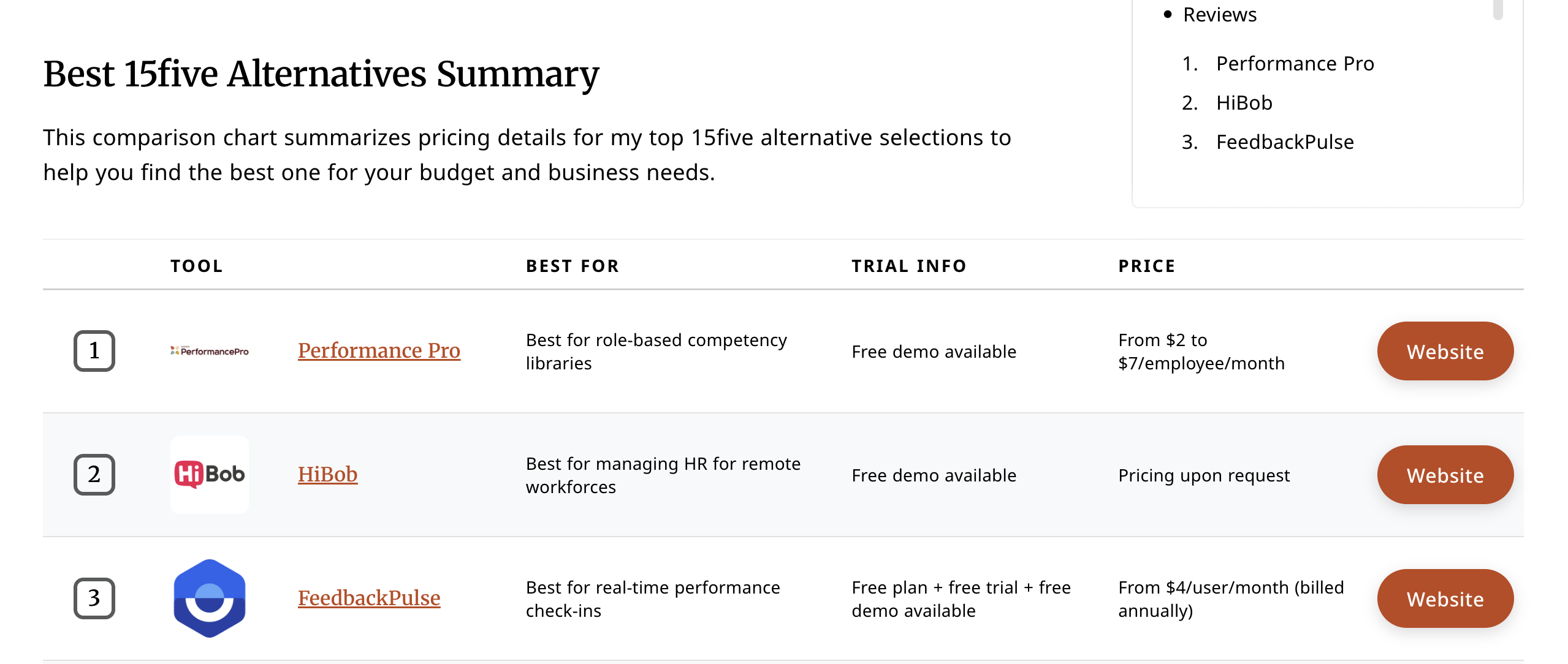
FeedbackPulse is worth a look when the brief is a lighter peer-feedback process rather than a full development or performance suite. Its public Peer Reviews page describes anonymous-by-default peer reviews, custom text and rating questions, question snapshots, optional review-cycle linking or ad-hoc reviews, response shuffling, reminders, and aggregated reporting after at least two anonymous peer reviews for a reviewee. Its solutions overview and growing-companies page provide broader marketing context, but those pages are not independent user evidence.
That profile can suit a team that wants to start with a bounded peer-feedback cycle and decide later whether it needs the wider governance and calibration surface of a performance suite. It is not a substitute for Culture Amp’s development-focused Effectiveness 360 or 15Five’s connected review routines on the evidence cited here. Verify employee nomination, calibration, reviewer visibility, reporting depth, exports, and implementation support before choosing it.
Source notes
Culture Amp — vendor-documented, verified:Effectiveness 360 FAQ for employees, checked August 30, 2026. It supports the development framing, documented perspectives, launch options, grouped feedback, and confidentiality qualification.
Culture Amp — vendor-documented, verify:Perform platform and products and service plans, checked August 30, 2026. They support the packaging caveat but do not establish a universal Effectiveness 360 entitlement or contract period.
15Five — vendor-documented, verified:Performance Reviews (Best-Self Review) feature overview, source updated August 14 and checked August 30, 2026. It supports review perspectives, calibration, Talent Matrix, goals, reporting, package requirement, and staged result sharing.
People Managing People — attributed editorial, verify:10 Best 15Five Alternatives Reviewed in 2026, checked August 30, 2026. The latest indexed snapshot places FeedbackPulse at #3 and labels it “Best for real-time performance check-ins”; a same-day cached variant showed #2, so the rank is a volatile publisher snapshot. Josh Barker’s first-person wording remains publisher voice, not customer testimony or a Best 360 Tools test.
Source note: This supplied capture is publisher-page context from People Managing People, captured August 30, 2026. It shows the publisher’s summary table, FeedbackPulse at #3, and the “Best for real-time performance check-ins” label. It is not a customer review, an independent product test, or proof of 15Five capability.
FeedbackPulse — vendor-documented, verified:Peer Reviews. The page supports only the bounded alternative summary above; it does not establish independent user experience, implementation outcomes, or a comparison result.
Selected reviewer context
What selected G2 reviews add to this comparison
These individual reviews add directional context to the assessment. They are not universal product facts.
Culture Amp
Positive signals
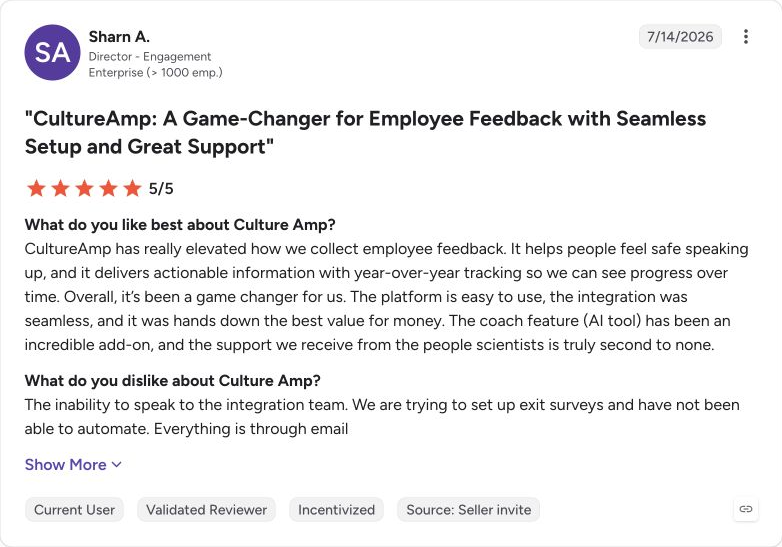
Source: G25/514 July 2026
Sharn A.
Feedback collection setup and support were described positively.
Effect on our assessment: Supports our assessment of approachable setup and support, but the experience may vary by team.
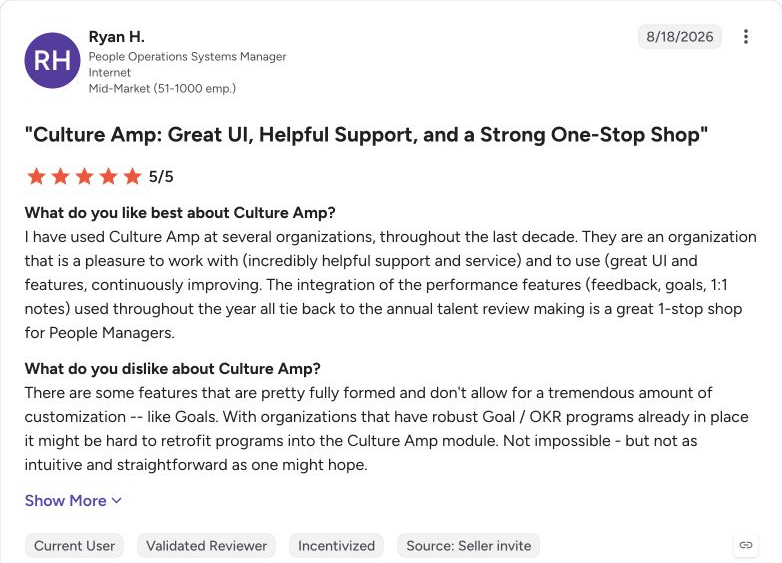
Source: G25/518 August 2026
Ryan H.
Integrated performance features and a one-stop shop.
Effect on our assessment: Supports our assessment of an integrated review workflow, while one review is directional rather than a universal product fact.
Critical signals
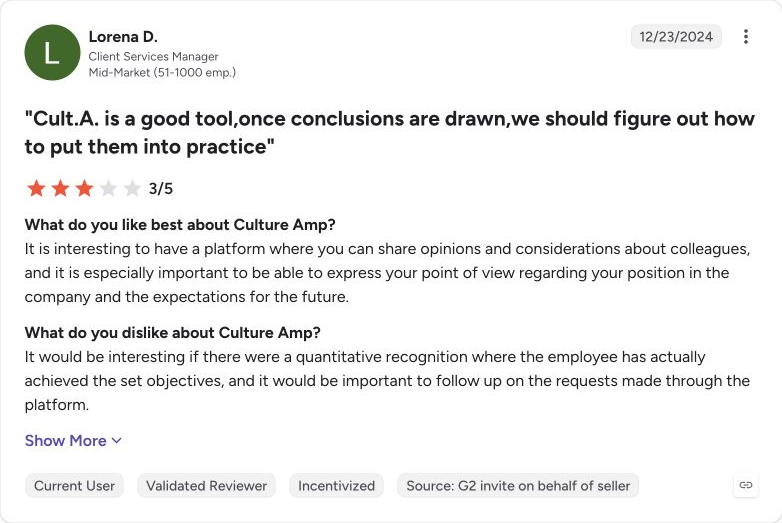
Source: G23/523 December 2024
Lorena D.
The reviewer questioned follow-through and recognition after feedback was collected.
Effect on our assessment: Adds a demo question about how feedback turns into visible follow-through; it does not establish a universal gap.
Source: G22.5/525 March 2026
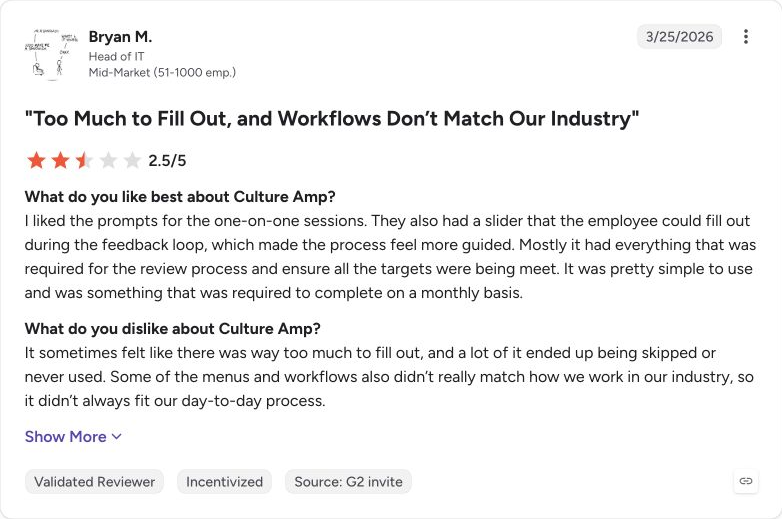
Bryan M.
The reviewer found too much to fill out and a mismatch with existing workflows.
Effect on our assessment: Tempers our assessment of workflow fit and adds a demo question about form length and process alignment.
15Five
Positive signals
Source: G25/519 July 2026
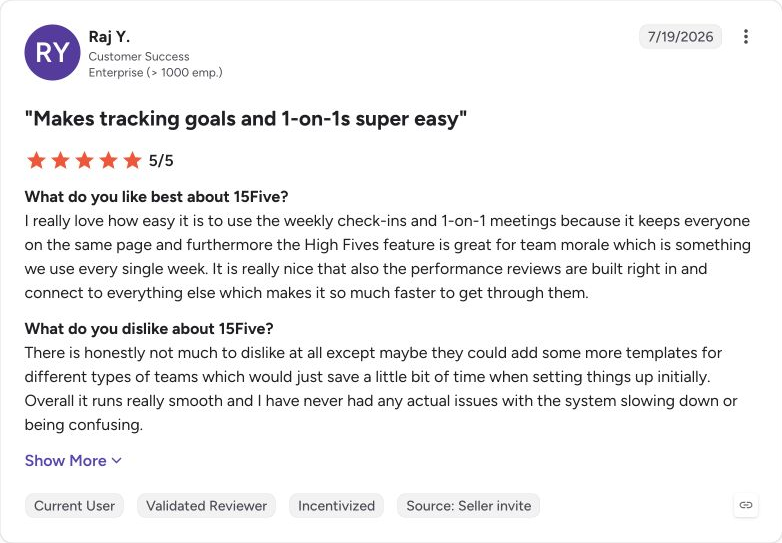
Raj Y.
Weekly check-ins, 1:1s, and performance reviews were praised.
Effect on our assessment: Supports our assessment of recurring check-ins and review continuity, while one review is directional rather than universal.
Source: G25/520 July 2026
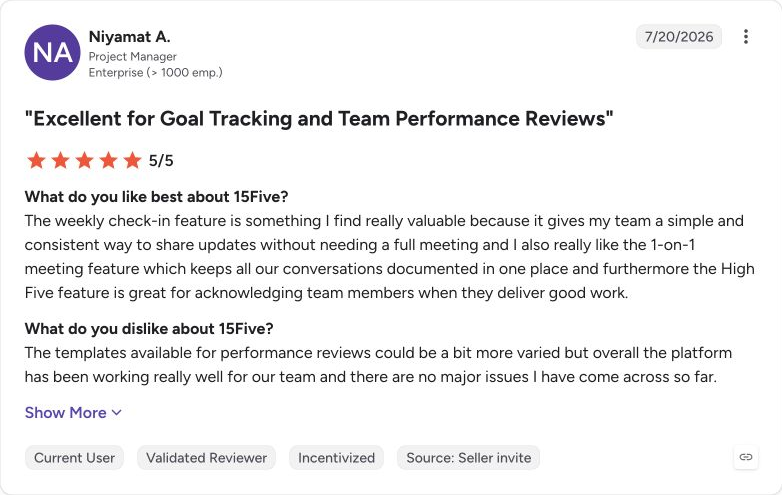
Niyamat A.
Check-ins, documented 1:1s, and recognition were praised.
Effect on our assessment: Supports our assessment of manager cadence and recognition workflows, but the experience may vary by team.
Critical signals
Source: G22.5/525 November 2025
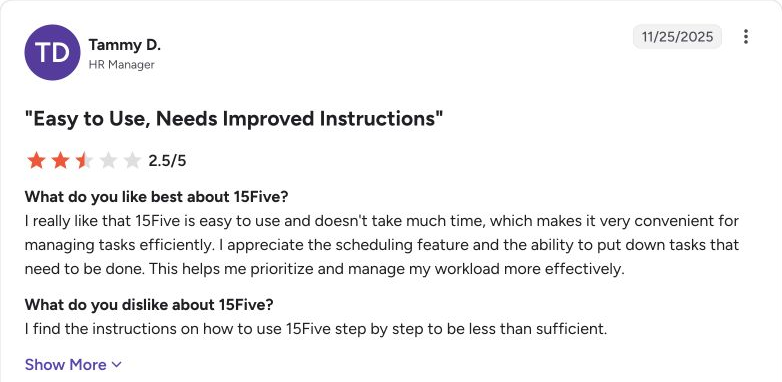
Tammy D.
Ease and scheduling were positives, but instructions were insufficient.
Effect on our assessment: Adds a demo question about guidance and administrator onboarding; one review does not establish a universal limitation.
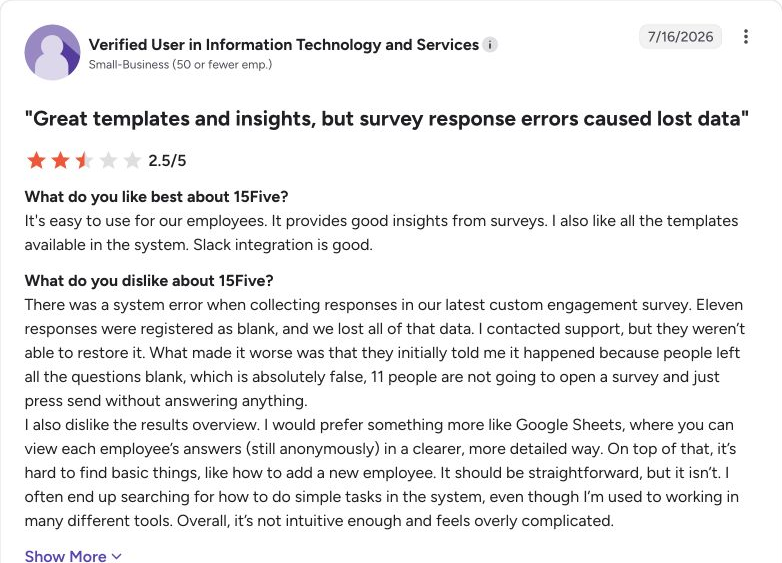
Source: G22.5/516 July 2026
Verified User in IT Services
Survey response data loss and results usability were concerns.
Effect on our assessment: Tempers our assessment of survey reliability and adds a demo question about data recovery and result handling.
Maya is a data-driven researcher with 8 years of experience analyzing HR technology trends. She specializes in workforce analytics platforms and has published extensively on employee engagement metrics. Her background in accounting gives her strong financial acumen when evaluating HR software ROI and implementation costs. She speaks fluent Hindi and English.
Akiko brings 6 years of expertise in enterprise HR systems and organizational transformation. She focuses on large-scale implementations and change management strategies. Her background in wealth management and corporate finance provides unique insights into how organizations optimize HR technology investments for long-term strategic value.
Iryna is a PhD-holding analyst with 10 years in HR tech research and market intelligence. She leads competitive analysis and strategic forecasting for the team. Her academic background in organizational psychology combined with practical experience in private equity portfolio optimization helps her identify which HR solutions drive real operational value.