Culture Amp is the cleaner fit when a 360 process is primarily a development intervention. Its Individual Effectiveness 360 support material describes self, manager, co-worker, and direct-report perspectives and explicitly separates growth-oriented feedback from performance evaluation. Trakstar Perform is the more natural fit when the organization wants 360 input inside a manager-mediated appraisal process with explicit control over rater requests, response tracking, and what copied feedback is shared.
The Trakstar conclusion needs careful wording. The available source is a manager guide for Trakstar Perform (Mitratech Trakstar), not proof that every tenant has the same settings. Depending on configuration, employees may suggest internal or external raters and explain their suggestions; the guide then describes managers requesting outside respondents, tracking responses, and copying, editing, or removing identifying information before sharing. Ask the vendor to demonstrate the active configuration. Culture Amp has its own package caveat: Perform and Effectiveness are separately listed, so a Perform subscription should not be assumed to include Individual Effectiveness 360.
At a glance: Culture Amp vs Trakstar Perform
This table uses the six Best 360 Tools lenses. A vendor record confirms that the source describes a workflow; it does not establish usability, implementation quality, or a guaranteed outcome. Trakstar entries are deliberately phrased as what its manager guide describes, with configuration checks where the guide is conditional.
Dimension
Culture Amp
Trakstar Perform (Mitratech Trakstar)
Cycle design
Individual Effectiveness 360 documents self, manager, co-worker, and direct-report perspectives; verify package and cycle settings.
The manager guide describes a scoring-stage workflow; depending on configuration, employees may suggest internal or external raters and explain their suggestions.
Trust and visibility
Confidentiality is qualified: a small reviewer group or specific example can make a contributor identifiable.
The guide describes managers copying, editing, or removing identifying information from copied feedback before sharing; verify active anonymity and sharing settings.
Feedback quality
Effectiveness 360 is framed around development and growth rather than performance evaluation.
The guide describes rater feedback handling, not question quality, competency design, or development outcomes.
Manager follow-through
Best suited to a development conversation, with the post-report coaching process to be designed and verified.
The guide describes pending, completed, and outstanding states, reminders, and manager-controlled sharing of copied feedback.
Operating fit
Perform is marketed around reviews, calibration, goals, and development, but implementation scope and Effectiveness access need confirmation.
The manager guide describes one workflow; current-site availability, integrations, implementation, and tenant-wide behavior require verification.
Commercial clarity
Effectiveness and Perform are separate entries in the plan matrix; 360 inclusion and contract period are verify.
The cited manager guide does not establish required plan, price, seats, services, or renewal terms.
How the 360 workflow differs
Culture Amp: development-first Effectiveness 360
The Culture Amp support FAQ describes Individual Effectiveness 360 as a development and growth workflow, not a performance-evaluation workflow. It documents self, manager, co-worker, and direct-report perspectives, with employee-driven or coach/admin-supported launch options and grouped feedback. That distinction is valuable when the organization wants a growth conversation that is not silently folded into appraisal.
The privacy language is qualified rather than absolute. A small reviewer group or a specific example can make a contributor identifiable, so a buyer should test minimum-group handling, raw-comment access, exports, and the boundary between a coach, an administrator, a manager, and the review subject.
The module boundary must be treated as part of the workflow. Culture Amp’s Perform page markets continuous feedback, reviews, calibrations, goals, and development; the service-plan matrix separately lists Perform and Effectiveness. Public material supports the Effectiveness 360 workflow, but not the assumption that every Perform customer receives it. Put the exact module, contract period, and included services in the proposal review.
Trakstar Perform: manager-described appraisal control
The Trakstar Perform manager guide describes an optional, scoring-stage 360 flow. Depending on configuration, employees may suggest internal or external raters and explain their suggestions. Managers can request outside respondents through secure links, track pending, completed, and outstanding states, and send reminders. This is a useful model for an appraisal process in which a manager remains responsible for assembling and reviewing the input.
The guide also describes a consequential sharing control: managers may copy feedback and edit or remove identifying information from copied comments; the copied feedback stays hidden unless it is shared. That can support deliberate review moderation, but it also means “anonymous” cannot be inferred from the presence of a 360 step. The guide does not make manager-owned assignment universal, does not settle legacy-site availability, and does not establish that every tenant uses the same anonymity mode or sharing behavior. Buyers should see the active settings and the employee-facing result before relying on the workflow.
Category verdicts
There is no universal winner. The right choice follows whether 360 is a development conversation or an appraisal input, and whether the vendor can demonstrate the exact trust and configuration boundaries your policy requires.
Category
Better fit on the public evidence
Why
Confidence
Development-focused 360
Culture Amp
Effectiveness 360 is explicitly framed around development and growth, with multiple feedback perspectives. Confirm that Effectiveness 360 is included in the proposed subscription.
Qualified
Manager-mediated appraisal workflow
Trakstar Perform, subject to configuration
The manager guide describes scoring-stage rater collection, response tracking, reminders, and manager-controlled feedback sharing. It does not make those settings universal.
Qualified
Trust and result visibility
Neither by default
Culture Amp qualifies confidentiality, while Trakstar’s guide describes manager editing/removal of identifying information before sharing. Test small groups, raw text, and exports in the active configuration.
Verify
Commercial clarity
Neither until proposal review
Culture Amp’s Effectiveness/Perform boundary and Trakstar’s unspecified package and terms both require written confirmation.
Verify
Buyer profiles
Growing companies
Choose Culture Amp when the immediate goal is a focused development 360 and consider Trakstar when the immediate goal is to keep 360 input inside a manager-owned appraisal process. A growing team should avoid assuming that a configurable manager workflow is low effort: ask who selects or approves raters, who handles outside respondents, and who can edit or share comments before committing.
Mid-market teams
Mid-market HR teams should compare the cost of workflow choice with the cost of governance. Culture Amp can fit a development-led program that keeps 360 distinct from appraisal; Trakstar can fit a process where managers need to control rater collection and result sharing. Validate the Culture Amp module boundary, Trakstar’s active configuration, administrator visibility, integrations, reporting, and support before selecting a standard.
Enterprise organizations
For enterprise use, make this a policy and operating-model review rather than a feature checklist. Culture Amp may fit a development-led 360, while Trakstar may fit an established appraisal process that needs manager-mediated controls. The cited public records do not prove implementation scale, data residency, integrations, support levels, or contract concessions, so those enterprise requirements remain explicitly verify until demonstrated and written into the proposal.
Questions to ask in a demo
In Culture Amp, is Individual Effectiveness 360 included in the proposed Perform plan, a combined plan, or a separate contract? Show the current plan document and renewal terms.
In Trakstar Perform, is employee rater suggestion enabled for this tenant? Show the exact configuration for internal and external raters, including who approves or changes a suggestion.
Invite an outside respondent through the secure-link flow. What do they see, how are pending/completed/outstanding states tracked, and which reminders are sent?
Copy a response containing identifying information. Show what a manager can edit or remove, what stays hidden, what is shared, and what the employee sees afterward.
Demonstrate the active anonymity mode, minimum-group behavior, raw-comment access, exports, legacy-site availability, and audit trail.
Which modules, seats, services, integrations, data-residency options, and support commitments are included in the actual proposal for each product?
Other options to consider
FeedbackPulse is worth a look when the brief is a lighter peer-feedback process rather than a full development or appraisal suite. Its public Peer Reviews page describes anonymous-by-default peer reviews, custom text and rating questions, question snapshots, optional review-cycle linking or ad-hoc reviews, response shuffling, reminders, and aggregated reporting after at least two anonymous peer reviews for a reviewee. Its solutions overview and growing-companies page provide broader marketing context, but those pages are not independent user evidence.
That profile can suit a team that wants a bounded peer-feedback cycle without immediately adopting a manager-mediated appraisal process. It is not a substitute for Culture Amp’s development-focused Effectiveness 360 or Trakstar’s configurable manager workflow on the evidence cited here. Verify employee nomination, calibration, reviewer visibility, reporting depth, exports, and implementation support before choosing it.
Source notes
Culture Amp — vendor-documented, verified:Effectiveness 360 FAQ for employees, checked August 30, 2026. It supports the development framing, documented perspectives, launch options, grouped feedback, and confidentiality qualification.
Culture Amp — vendor-documented, verify:Perform platform and products and service plans, checked August 30, 2026. They support the packaging caveat but do not establish a universal Effectiveness 360 entitlement or contract period.
Trakstar Perform — vendor-documented, verified:360-Rater Feedback Deep Dive for Managers, source updated July 23 and checked August 30, 2026. It supports only what the manager guide describes: conditional rater suggestions, outside respondents, response tracking, reminders, and manager-controlled copying/editing/removal and sharing. Current-site availability, anonymity mode, and tenant behavior require buyer verification.
FeedbackPulse — vendor-documented, verified:Peer Reviews. The page supports only the bounded alternative summary above; it does not establish independent user experience, implementation outcomes, or a comparison result.
Selected reviewer context
What selected G2 reviews add to this comparison
These individual reviews add directional context to the assessment. They are not universal product facts.
Culture Amp
Positive signals
Source: G25/514 July 2026
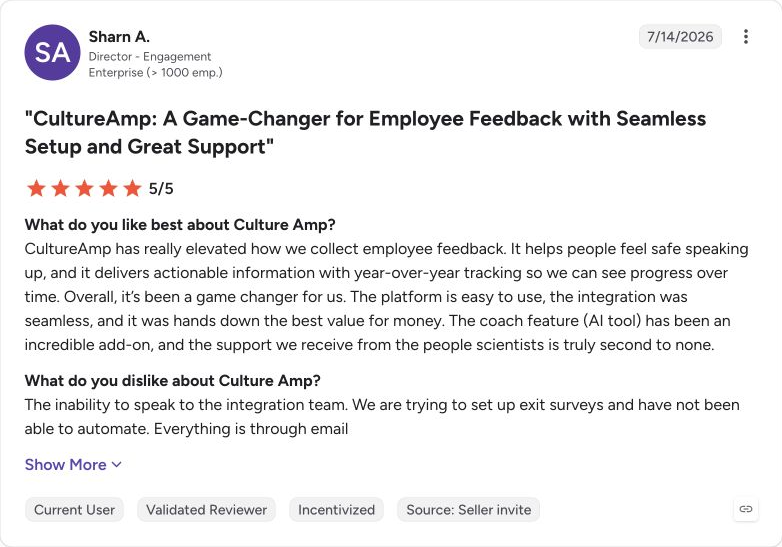
Sharn A.
Feedback collection setup and support were described positively.
Effect on our assessment: Supports our assessment of approachable setup and support, but the experience may vary by team.
Source: G25/518 August 2026
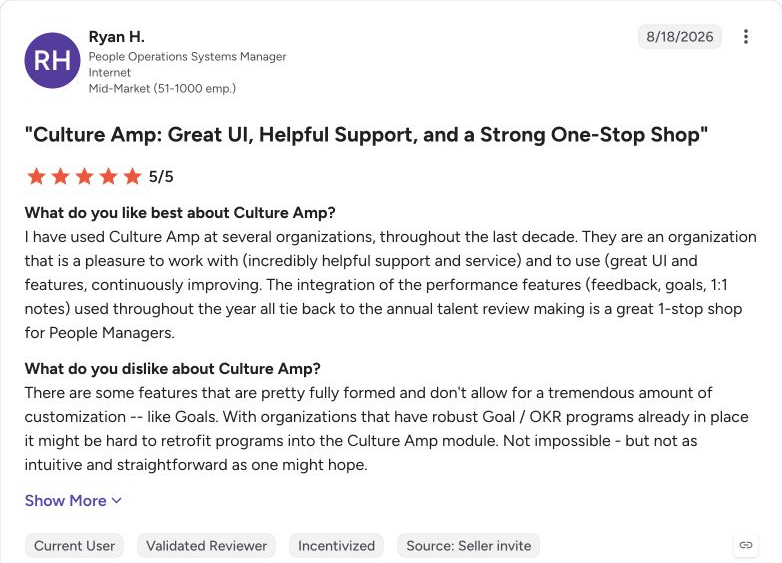
Ryan H.
Integrated performance features and a one-stop shop.
Effect on our assessment: Supports our assessment of an integrated review workflow, while one review is directional rather than a universal product fact.
Critical signals
Source: G23/523 December 2024
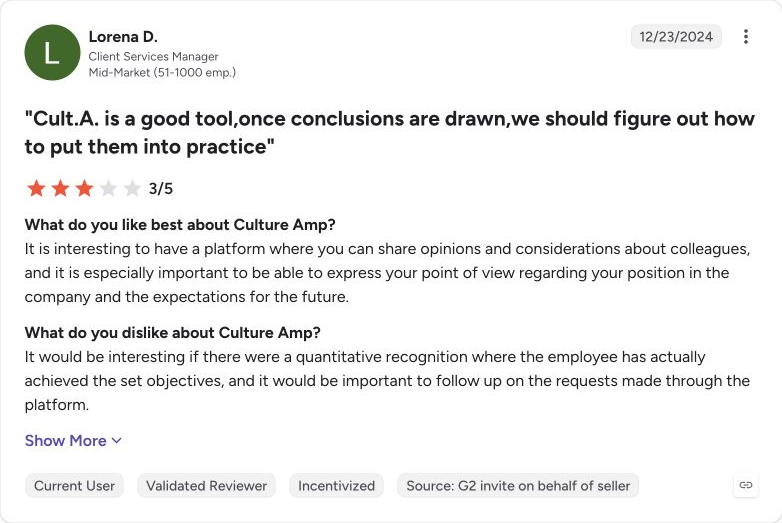
Lorena D.
The reviewer questioned follow-through and recognition after feedback was collected.
Effect on our assessment: Adds a demo question about how feedback turns into visible follow-through; it does not establish a universal gap.
Source: G22.5/525 March 2026
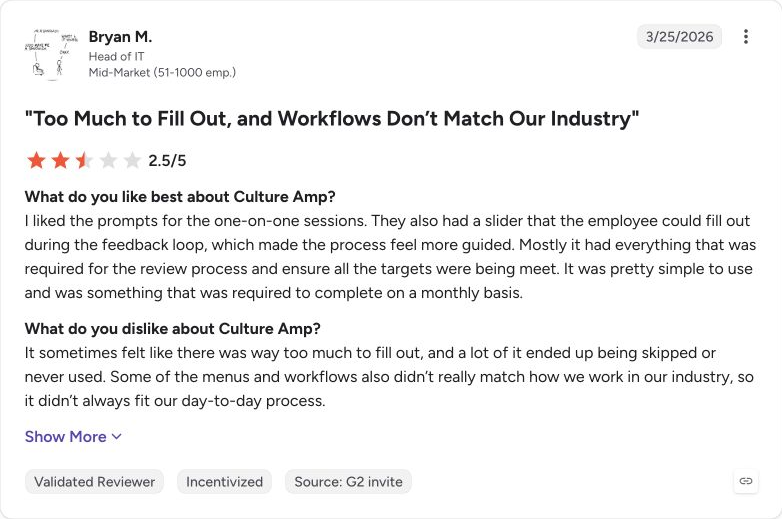
Bryan M.
The reviewer found too much to fill out and a mismatch with existing workflows.
Effect on our assessment: Tempers our assessment of workflow fit and adds a demo question about form length and process alignment.
Trakstar
Source: G2The checked G2 Trakstar Perform review URL redirected to the Performance Management category and said the product is no longer valid. This does not establish whether historical product reviews exist, so no captures are shown.
Akiko brings 6 years of expertise in enterprise HR systems and organizational transformation. She focuses on large-scale implementations and change management strategies. Her background in wealth management and corporate finance provides unique insights into how organizations optimize HR technology investments for long-term strategic value.
Santiago is a talented analyst with 5 years of experience specializing in talent acquisition and management software. He is passionate about understanding how HR tech impacts diversity and inclusion initiatives. His background in healthcare and hospice operations gives him deep empathy for employee wellness and cultural considerations in tech selection.
Iryna is a PhD-holding analyst with 10 years in HR tech research and market intelligence. She leads competitive analysis and strategic forecasting for the team. Her academic background in organizational psychology combined with practical experience in private equity portfolio optimization helps her identify which HR solutions drive real operational value.