Culture Amp is the more natural fit when the purpose of a 360 exercise is employee development and growth. Its Effectiveness 360 support material describes self, manager, co-worker, and direct-report perspectives, plus grouped feedback with confidentiality qualifications. That evidence is specifically about Individual Effectiveness 360, not a blanket promise that every Culture Amp Perform customer has the module.
Lattice is the more natural fit when a team wants a manager-governed review routine. The current Lattice guide describes self, manager, direct-report, and peer perspectives, including peer nomination and manager approval, followed by manager-controlled packet sharing. The source was rechecked on 31 August 2026; tenant settings and implementation details still belong in the demo checklist.
There is no universal winner. Choose Culture Amp for a development-led conversation only after checking the proposed Effectiveness 360 package. Choose Lattice when nomination approval and manager-controlled delivery match your governance policy, after checking current visibility settings and commercial terms.
At a glance
Dimension
Culture Amp
Lattice
Cycle design
Individual Effectiveness 360 documents self, manager, co-worker, and direct-report perspectives, with employee- or coach/admin-supported launch. Rater-selection detail remains to verify.
The current guide documents self, manager, direct-report, and peer perspectives. Peers can be nominated, then approved, added, or removed by a manager; confirm the intended tenant configuration during due diligence.
Trust and visibility
Feedback is grouped with confidentiality qualifications. A small reviewer group or a specific example can make a contributor identifiable, so this is not an anonymous-by-default promise.
The guide describes manager-controlled packet sharing after review writing. Confirm whether the current tenant uses anonymized or named delivery and who can see free text.
Feedback quality
The documented Effectiveness 360 purpose is development and growth. The source does not establish the complete question bank, rating scale, or calibration design for your plan.
The documented multi-rater flow supplies several perspectives, but the checked guide does not settle question design, calibration, or synthesis quality.
Manager follow-through
The employee- or coach/admin-supported workflow can support a development conversation, but the record does not prove a complete goals or coaching handoff.
Manager approval of raters and control of final packet sharing are documented. Post-report coaching, goal linkage, and repeatable habits still need a demo.
Operating fit
Perform is marketed around continuous feedback, reviews, calibrations, goals, and development, but the Effectiveness 360 boundary, implementation scope, and integrations remain to verify.
The checked 360 document does not establish HRIS alignment, integrations, implementation support, or administrative effort. Treat operating fit as a buyer question.
Commercial clarity
Culture Amp’s matrix lists Perform and Effectiveness separately. Exact 360 entitlement and contract period require a proposal or plan document.
The checked workflow document does not state plan inclusion, seat minimums, services, or contract terms. Ask for the complete commercial scope.
How the workflows differ
Culture Amp: development-first Effectiveness 360
Culture Amp’s employee FAQ draws a meaningful boundary: Individual Effectiveness 360 is described as supporting development and growth rather than performance evaluation. It documents self, manager, co-worker, and direct-report feedback and describes an employee-driven or coach/admin-supported workflow that returns grouped feedback.
That boundary matters when a buyer says “360 review” but really wants a scored appraisal, calibration meeting, or compensation input. The available record does not establish those uses for Effectiveness 360. It also warns that confidentiality can be weakened when the reviewer group is small or an example makes the contributor identifiable. Do not rewrite that as guaranteed anonymity.
Culture Amp’s separate Perform page markets continuous feedback, performance reviews, calibrations, goals, and employee development. The products-and-service-plans matrix lists Perform-only, Effectiveness-only, and combined options for newer subscriptions. Because the exact 360 entitlement and contract period are not proven in the public records, ask the vendor to identify the module and terms in the proposal rather than inferring them from generic Perform language.
Lattice: manager-approved multi-rater review
The checked Lattice help article describes a 360 review with self, manager, direct-report, and peer input. It says peers can be nominated and that a manager can approve, add, or remove nominees. That is a useful governance distinction: the process is not simply an open invitation for participants to choose anyone without manager oversight.
The same guide describes review writing followed by manager-controlled packet sharing rather than automatic participant access. That makes delivery policy a central buying question. Ask to see the exact anonymous-versus-named configuration, the role that can change it, and what happens to comments when a packet is shared.
The source record was rechecked on 31 August 2026 and confirms the scoped review workflow. It does not establish a universal tenant configuration or implementation outcome. A walkthrough should still settle the question model, calibration steps, exports, and any integration or implementation work.
Category verdicts
Best for development purpose: Culture Amp
Culture Amp has the clearer documented development boundary. That is the strongest distinction when the 360 conversation is meant to identify growth areas rather than feed a formal performance score. The verdict is conditional on the buyer confirming that Individual Effectiveness 360 is actually in the proposed package and that its confidentiality model fits the intended audience.
Best for review-cycle governance: Lattice
Lattice has the clearer documented manager checkpoints: peer nomination, manager approval or editing of the rater set, and manager-controlled packet sharing. It is the better fit when those controls are central to policy. Because the source review date has passed, confirm the current tenant behavior before relying on this fit.
Trust and visibility: neither earns a blanket win
Culture Amp’s source states confidentiality qualifications, while Lattice’s source states manager-controlled sharing. Neither record proves a universal anonymity threshold, role-level access policy, or free-text export rule. Treat trust as a configuration decision and make the vendor show the full path from nomination to final report.
Commercial clarity: verify both proposals
The available sources do not support a commercial winner. Culture Amp’s separate products and service-plan records make the module boundary visible but leave 360 inclusion and contract terms to the buyer’s proposal. The Lattice workflow record does not cover plan packaging or contract terms. A quote is not complete until the required modules, seats, services, renewal terms, and 360 scope are written down.
Buyer profiles
Growing companies
Culture Amp is a candidate when a growing team wants a development-led 360 conversation and can assign a coach or administrator to support the workflow. The package must be confirmed first, and the team should test whether grouped feedback remains useful at its likely reviewer counts. Lattice is a candidate when a manager-owned nomination and sharing routine is more important than a lightweight launch; the checked evidence does not establish its setup burden, so ask for an implementation walk-through.
Mid-market organizations
Mid-market buyers should decide whether their repeatable process is development-first or governance-first. Culture Amp’s documented Effectiveness 360 purpose fits the former; Lattice’s documented manager checkpoints fit the latter. Neither source settles role permissions, calibration, integrations, or package scope, so make those explicit acceptance criteria rather than treating the table as a score.
Enterprise organizations
The enterprise evidence is insufficient for a confident platform recommendation. The checked records do not establish SSO or HRIS integration, regional controls, implementation services, data-handling commitments, or negotiated contract terms for either product. An enterprise buyer should require a tenant-specific workflow demo, a security and data review, and a proposal that names the exact 360 module before selecting a platform.
Questions to ask in a demo
For Culture Amp, is Individual Effectiveness 360 included in the proposed Perform, Effectiveness, or combined package? Which contract period and service terms apply?
Is Culture Amp’s Effectiveness 360 intended to remain development-focused, or can the proposed configuration support a formal performance-evaluation use case?
For each product, who can nominate, approve, add, or remove raters, and can the buyer enforce minimum group sizes?
Show the exact result-sharing path: who sees identities, written comments, grouped feedback, exports, and audit history?
In Lattice, which roles control packet sharing, and can the tenant switch between anonymized and names-attached delivery?
Which question, rating, competency, calibration, goal, and coaching features are included in the quoted plans rather than optional modules?
What integrations and implementation support are included, and what administrative work remains with the buyer after launch?
Other options to consider
FeedbackPulse’s peer-reviews page documents anonymous-by-default peer reviews with custom text and rating questions, question snapshots, optional review-cycle linking or ad-hoc reviews, response shuffling, reminders, and aggregated reporting after at least two anonymous peer reviews for a reviewee in a cycle.
That makes FeedbackPulse a candidate to test when a growing team wants a focused peer-feedback workflow alongside, rather than a replacement for, a development or performance suite. The public page alone does not establish rater-governance depth, calibration, HRIS integrations, package terms, or implementation outcomes; ask to see those paths before treating it as the right alternative.
Sources and evidence
Culture Amp: Effectiveness 360 FAQ for Employees — vendor-documented, verified; establishes the development framing, perspectives, grouped feedback, and confidentiality qualifications for Individual Effectiveness 360.
Culture Amp: Products and service plans — vendor-documented, verify; lists Perform and Effectiveness options separately, while detailed 360 inclusion and contract terms remain proposal-dependent.
Lattice: Write a 360 Review — vendor-documented, verified; rechecked on 31 August 2026 and confirms perspectives, peer nomination, manager approval, and manager-controlled sharing.
These individual reviews add directional context to the assessment. They are not universal product facts.
Culture Amp
Positive signals
Source: G25/514 July 2026
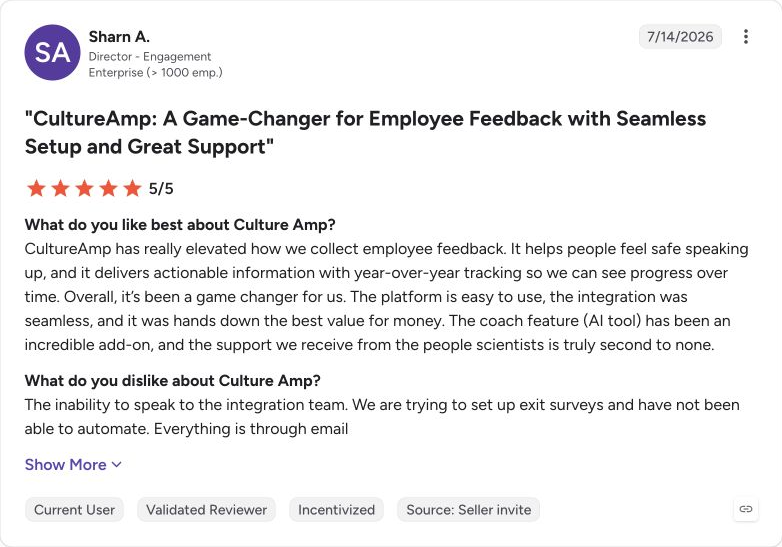
Sharn A.
Feedback collection setup and support were described positively.
Effect on our assessment: Supports our assessment of approachable setup and support, but the experience may vary by team.
Source: G25/518 August 2026
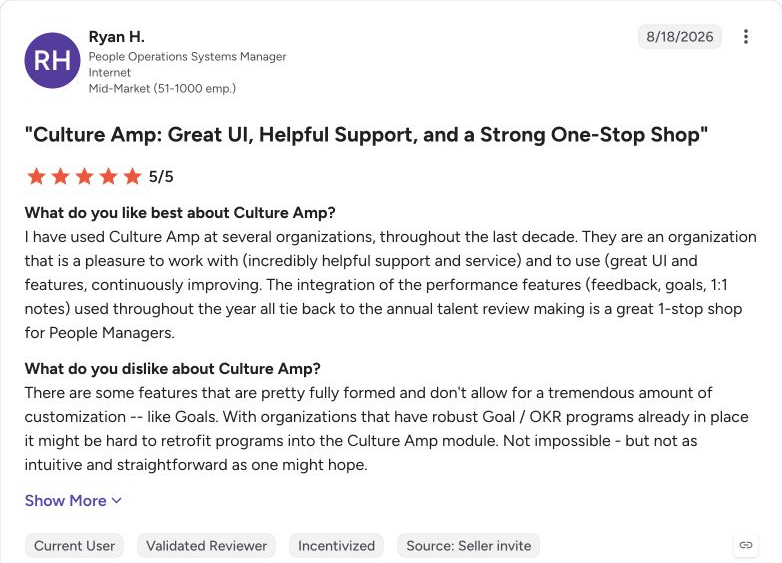
Ryan H.
Integrated performance features and a one-stop shop.
Effect on our assessment: Supports our assessment of an integrated review workflow, while one review is directional rather than a universal product fact.
Critical signals
Source: G23/523 December 2024
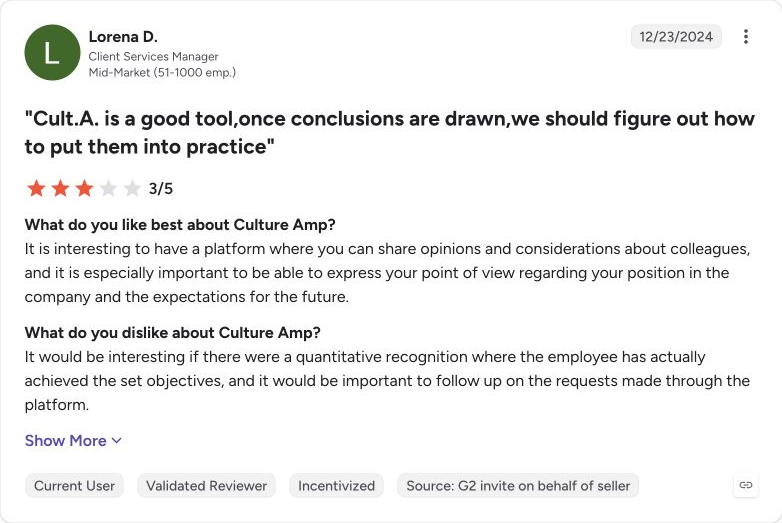
Lorena D.
The reviewer questioned follow-through and recognition after feedback was collected.
Effect on our assessment: Adds a demo question about how feedback turns into visible follow-through; it does not establish a universal gap.
Source: G22.5/525 March 2026
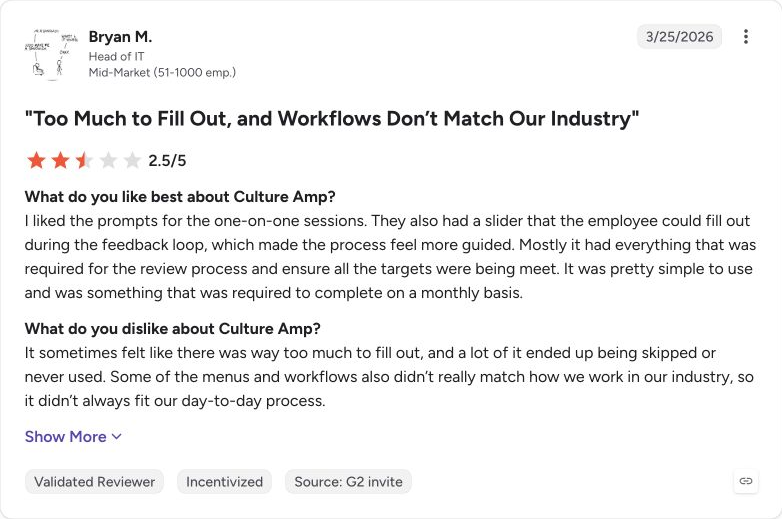
Bryan M.
The reviewer found too much to fill out and a mismatch with existing workflows.
Effect on our assessment: Tempers our assessment of workflow fit and adds a demo question about form length and process alignment.
Lattice
Positive signals
Source: G25/527 August 2026
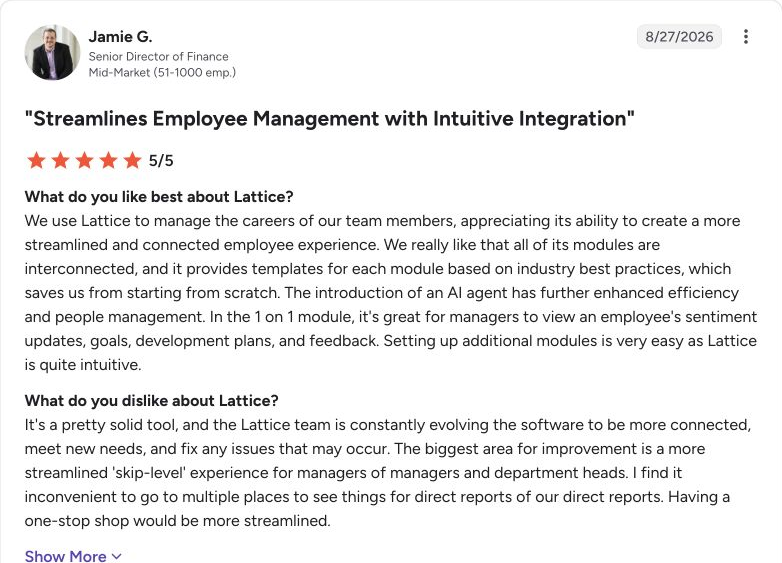
Jamie G.
Connected modules, templates, and an intuitive setup were highlighted.
Effect on our assessment: Supports our assessment of connected setup and reusable review structure, while one review is directional rather than universal.
Source: G25/510 October 2023
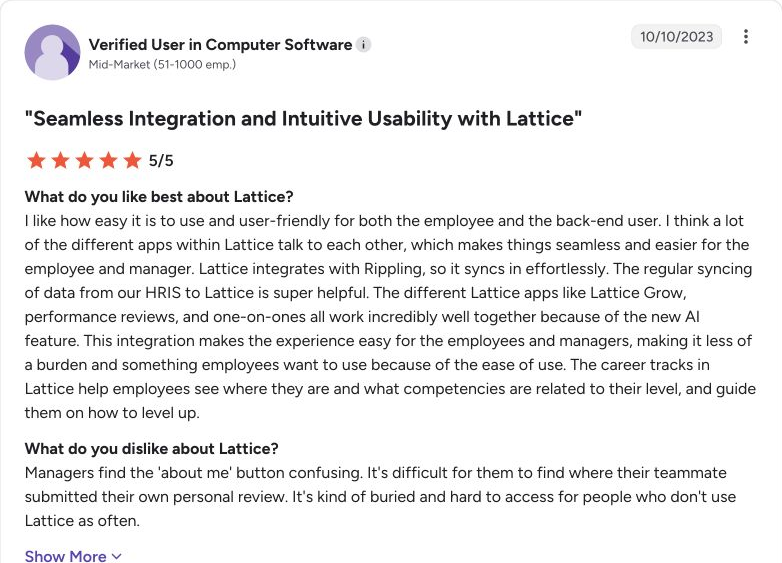
Verified User in Computer Software
Integrations, usability, and HRIS sync were highlighted.
Effect on our assessment: Supports our assessment of integration and usability signals, but the older review should be confirmed against today's workflow.
Critical signals
Source: G23/510 April 2025
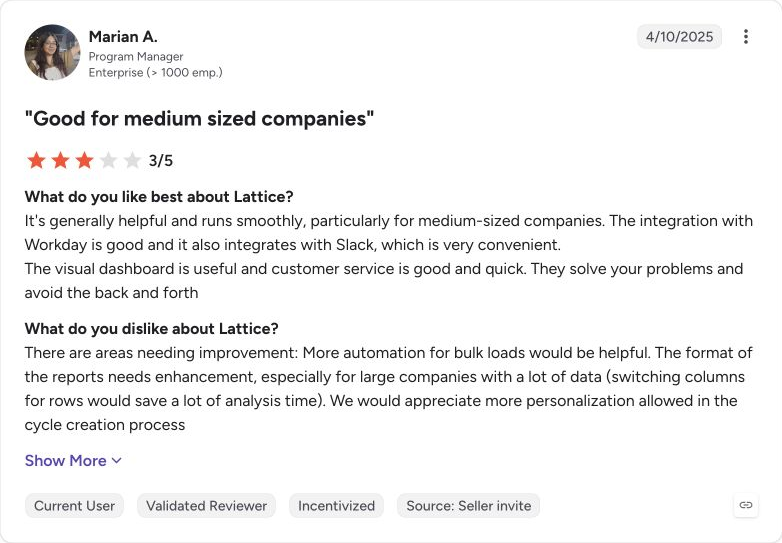
Marian A.
Reporting, bulk-load automation, and personalization were pain points.
Effect on our assessment: Tempers our assessment of administrative fit and adds a demo question about reporting and bulk updates.
Source: G23/516 April 2026
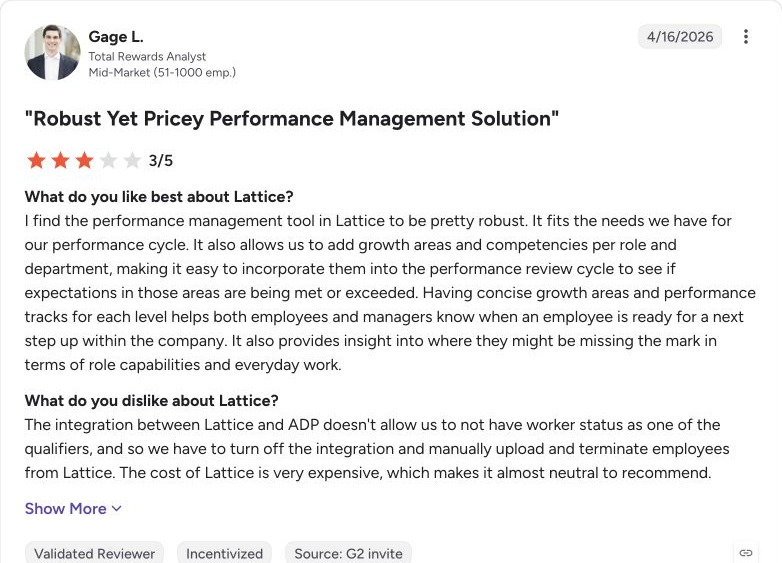
Gage L.
A robust performance cycle was paired with ADP integration and cost concerns.
Effect on our assessment: Adds a demo question about ADP integration and total cost; one review does not establish a universal limitation.
Maya is a data-driven researcher with 8 years of experience analyzing HR technology trends. She specializes in workforce analytics platforms and has published extensively on employee engagement metrics. Her background in accounting gives her strong financial acumen when evaluating HR software ROI and implementation costs. She speaks fluent Hindi and English.
James is a rising talent in HR software analysis with 2 years of experience. He brings fresh perspectives on emerging technologies like AI and machine learning in HR platforms. His background in software engineering gives him technical credibility when evaluating platform capabilities and integration potential.
Akiko brings 6 years of expertise in enterprise HR systems and organizational transformation. She focuses on large-scale implementations and change management strategies. Her background in wealth management and corporate finance provides unique insights into how organizations optimize HR technology investments for long-term strategic value.