Culture Amp is the cleaner fit when a 360 process is primarily a development intervention. Its Individual Effectiveness 360 support material describes self, manager, co-worker, and direct-report perspectives and explicitly separates growth-oriented feedback from performance evaluation. PerformYard is the stronger starting point when HR needs to configure who can participate, how stages and due dates work, whether approvals or signers are required, and whether an outside respondent can complete a form without an account.
The Culture Amp answer comes with a commercial boundary: its Perform page uses broad 360 and effectiveness language, but the current service-plan matrix lists Perform and Effectiveness separately. Do not assume a Perform subscription includes Individual Effectiveness 360. PerformYard’s setup guide is specific about workflow mechanics, but it does not establish price, implementation support, or the full privacy behavior of the proposed configuration. Neither product should be treated as anonymous-by-default without a policy-level demonstration.
At a glance: Culture Amp vs PerformYard
This table uses the six Best 360 Tools lenses. A vendor record confirms that the source describes a workflow; it does not establish usability, implementation quality, or a guaranteed outcome. The unresolved items are deliberate demo and proposal questions.
Dimension
Culture Amp
PerformYard
Cycle design
Individual Effectiveness 360 documents self, manager, co-worker, and direct-report perspectives; verify package and cycle settings.
Employees, review subjects, managers, and administrators can add forms; subjects and managers can nominate evaluators with approvals, signers, dates, and request messages.
Trust and visibility
Confidentiality is qualified: a small reviewer group or specific example can make a contributor identifiable.
Author redaction is described as hiding authors from subjects and managers, not as administrator-level anonymity; recheck the active configuration.
Feedback quality
Effectiveness 360 is framed around development and growth rather than performance evaluation.
Forms, stages, approvals, signers, and request messages are documented; prompt quality and synthesis need a real-cycle test.
Manager follow-through
Best suited to a development conversation, with the post-report coaching process to be designed and verified.
360 forms sit inside broader performance discussions, with due dates and requests that can support follow-through.
Operating fit
Perform is marketed around reviews, calibration, goals, and development, but implementation scope and Effectiveness access need confirmation.
The setup guide covers several participant and administrator paths plus external forms; integrations and rollout effort are not established.
Commercial clarity
Effectiveness and Perform are separate entries in the plan matrix; 360 inclusion and contract period are verify.
The cited setup guide does not establish required plan, price, seats, services, or renewal terms.
How the 360 workflow differs
Culture Amp: development-first Effectiveness 360
The Culture Amp support FAQ describes Individual Effectiveness 360 as a development and growth workflow, not a performance-evaluation workflow. It documents self, manager, co-worker, and direct-report perspectives, with employee-driven or coach/admin-supported launch options and grouped feedback. That distinction is valuable when the organization wants a growth conversation that is not silently folded into appraisal.
The privacy language is qualified rather than absolute. A small reviewer group or a specific example can make a contributor identifiable, so a buyer should test minimum-group handling, raw-comment access, exports, and the boundary between a coach, an administrator, a manager, and the review subject.
The module boundary must be treated as part of the workflow. Culture Amp’s Perform page markets continuous feedback, reviews, calibrations, goals, and development; the service-plan matrix separately lists Perform and Effectiveness. Public material supports the Effectiveness 360 workflow, but not the assumption that every Perform customer receives it. Put the exact module, contract period, and included services in the proposal review.
PerformYard: configurable review stages and respondents
PerformYard’s setup guide places 360 forms inside annual, semiannual, or regular performance discussions. It describes a broad set of entry points: an employee, review subject, manager, or administrator can add a form; subjects and managers can nominate evaluators; and a workflow can include optional approvals, signers, fixed or relative due dates, and request messages. External forms can collect feedback from reviewers without a PerformYard account.
That configurability is useful when one standard cycle has to accommodate different populations or outside stakeholders. It also creates more policy decisions. The older author-redaction documentation says redaction hides authors from subjects and managers but does not make feedback fully anonymous because administrators can see authors. The direct redaction page currently requires a support login, so treat the detail as a caveat to recheck, not as a timeless guarantee. Ask to see the exact settings and a completed report before calling the workflow confidential.
Category verdicts
There is no universal winner. The right choice follows the review’s job, the level of workflow configuration needed, and whether the proposal settles the remaining trust and package questions.
Category
Better fit on the public evidence
Why
Confidence
Development-focused 360
Culture Amp
Effectiveness 360 is explicitly framed around development and growth, with multiple feedback perspectives. Confirm that Effectiveness 360 is included in the proposed subscription.
Qualified
Configurable stages and outside respondents
PerformYard
Its setup guide documents several participant paths, evaluator nomination, approvals, signers, due-date choices, request messages, and external forms.
Qualified
Trust and result visibility
Neither by default
Culture Amp qualifies confidentiality, while PerformYard’s redaction caveat does not equal administrator-level anonymity. Test small groups, free text, raw access, and exports.
Verify
Commercial clarity
Neither until proposal review
Culture Amp’s Effectiveness/Perform boundary and PerformYard’s unspecified package and terms both require written confirmation.
Verify
Buyer profiles
Growing companies
Choose Culture Amp when the immediate goal is a focused development 360 and choose PerformYard when the immediate goal is a configurable performance discussion with different participant paths. A growing team should resist paying for flexibility it will not administer: ask who owns nominations, approvals, reminders, redaction, and the outside-respondent process before committing.
Mid-market teams
Mid-market HR teams should compare the cost of workflow choice with the cost of governance. Culture Amp can fit a development-led program that keeps 360 distinct from appraisal; PerformYard can fit a process that needs formal stages, signers, evaluator approvals, and external forms. Validate the current Culture Amp module boundary, PerformYard’s support model, administrator visibility, integrations, and reporting before selecting a standard.
Enterprise organizations
For enterprise use, make this a policy and operating-model review rather than a feature checklist. Culture Amp may fit a development-led 360, while PerformYard may fit complex review populations and outside respondents. The cited public records do not prove implementation scale, data residency, integrations, support levels, or contract concessions, so those enterprise requirements remain explicitly verify until demonstrated and written into the proposal.
Questions to ask in a demo
In Culture Amp, is Individual Effectiveness 360 included in the proposed Perform plan, a combined plan, or a separate contract? Show the current plan document and renewal terms.
In PerformYard, who can add a 360 form, nominate evaluators, approve them, sign off, change dates, and send requests for each employee population?
Invite an external respondent without an account. What do they see, how is the response connected to the review, and what happens if the link expires?
Configure a small reviewer group and an identifying comment. Who can see the author, raw text, redacted text, and export at each stage?
Show how a manager or administrator handles incomplete forms, a changed reporting line, a missed due date, and a request that needs to be withdrawn.
Which modules, seats, services, integrations, data-residency options, and support commitments are included in the actual proposal for each product?
Other options to consider
FeedbackPulse is worth a look when the brief is a lighter peer-feedback process rather than a full development or performance suite. Its public Peer Reviews page describes anonymous-by-default peer reviews, custom text and rating questions, question snapshots, optional review-cycle linking or ad-hoc reviews, response shuffling, reminders, and aggregated reporting after at least two anonymous peer reviews for a reviewee. Its solutions overview and growing-companies page provide broader marketing context, but those pages are not independent user evidence.
That profile can suit a team that wants a bounded peer-feedback cycle without immediately adopting a configurable performance-review process. It is not a substitute for Culture Amp’s development-focused Effectiveness 360 or PerformYard’s staged 360 setup on the evidence cited here. Verify employee nomination, calibration, reviewer visibility, reporting depth, exports, and implementation support before choosing it.
Source notes
Culture Amp — vendor-documented, verified:Effectiveness 360 FAQ for employees, checked August 30, 2026. It supports the development framing, documented perspectives, launch options, grouped feedback, and confidentiality qualification.
Culture Amp — vendor-documented, verify:Perform platform and products and service plans, checked August 30, 2026. They support the packaging caveat but do not establish a universal Effectiveness 360 entitlement or contract period.
PerformYard — vendor-documented, verified:Setting Up 360 Reviews, source updated August 17 and checked August 30, 2026. It supports participant paths, evaluator nomination, approvals, signers, dates, requests, external forms, and the author-redaction caveat to confirm during due diligence.
FeedbackPulse — vendor-documented, verified:Peer Reviews. The page supports only the bounded alternative summary above; it does not establish independent user experience, implementation outcomes, or a comparison result.
Selected reviewer context
What selected G2 reviews add to this comparison
These individual reviews add directional context to the assessment. They are not universal product facts.
Culture Amp
Positive signals
Source: G25/514 July 2026
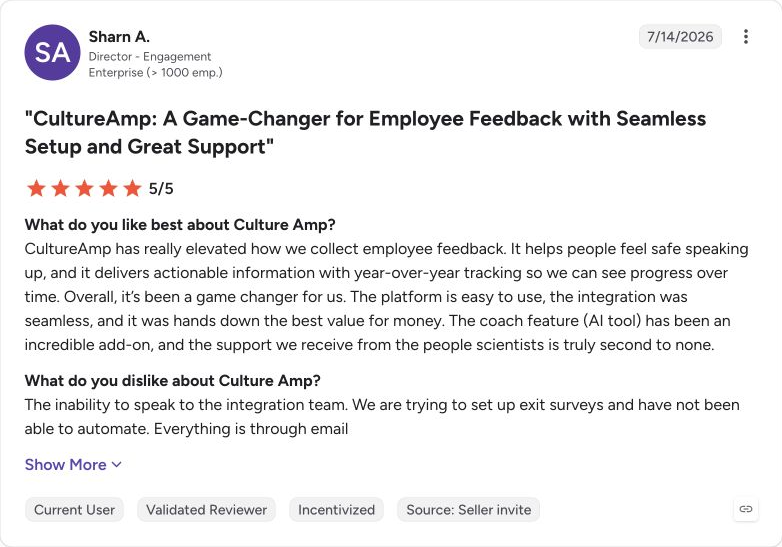
Sharn A.
Feedback collection setup and support were described positively.
Effect on our assessment: Supports our assessment of approachable setup and support, but the experience may vary by team.
Source: G25/518 August 2026
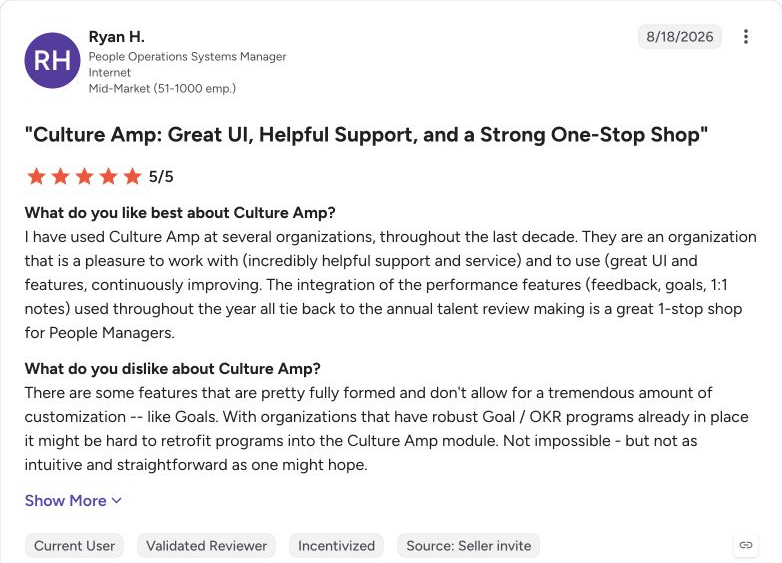
Ryan H.
Integrated performance features and a one-stop shop.
Effect on our assessment: Supports our assessment of an integrated review workflow, while one review is directional rather than a universal product fact.
Critical signals
Source: G23/523 December 2024
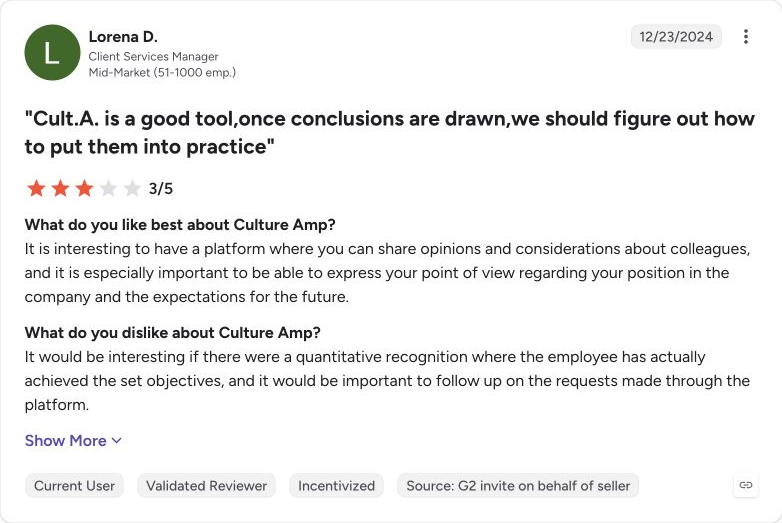
Lorena D.
The reviewer questioned follow-through and recognition after feedback was collected.
Effect on our assessment: Adds a demo question about how feedback turns into visible follow-through; it does not establish a universal gap.
Source: G22.5/525 March 2026
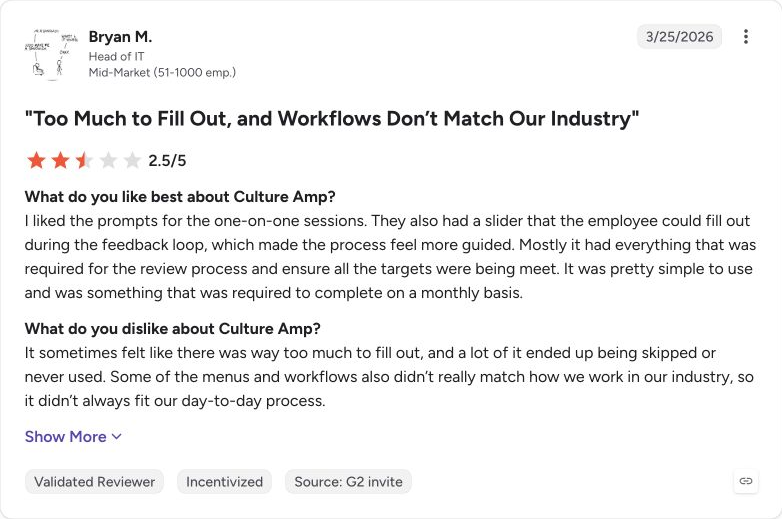
Bryan M.
The reviewer found too much to fill out and a mismatch with existing workflows.
Effect on our assessment: Tempers our assessment of workflow fit and adds a demo question about form length and process alignment.
PerformYard
Positive signals
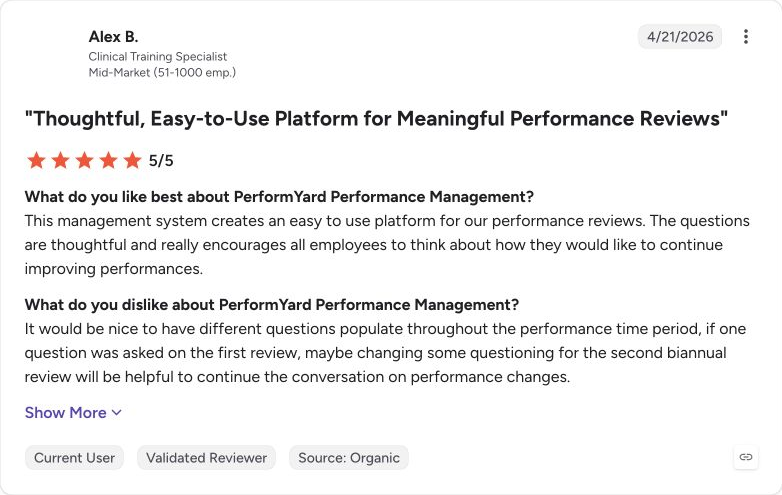
Source: G25/521 April 2026
Alex B.
A usable review platform and thoughtful prompts were highlighted.
Effect on our assessment: Supports our assessment of approachable review design, but the experience may vary by implementation.
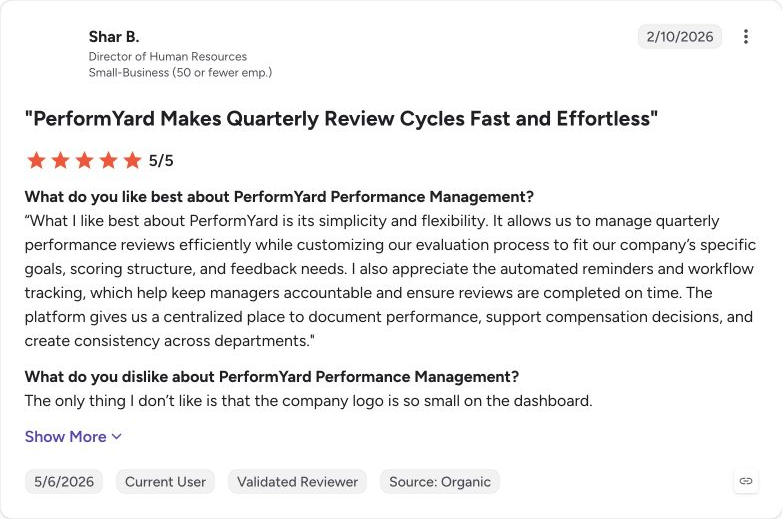
Source: G25/510 February 2026
Shar B.
Quarterly-cycle simplicity, flexibility, and reminders were praised.
Effect on our assessment: Supports our assessment of a manageable review cadence, while one review is directional rather than universal.
Critical signals
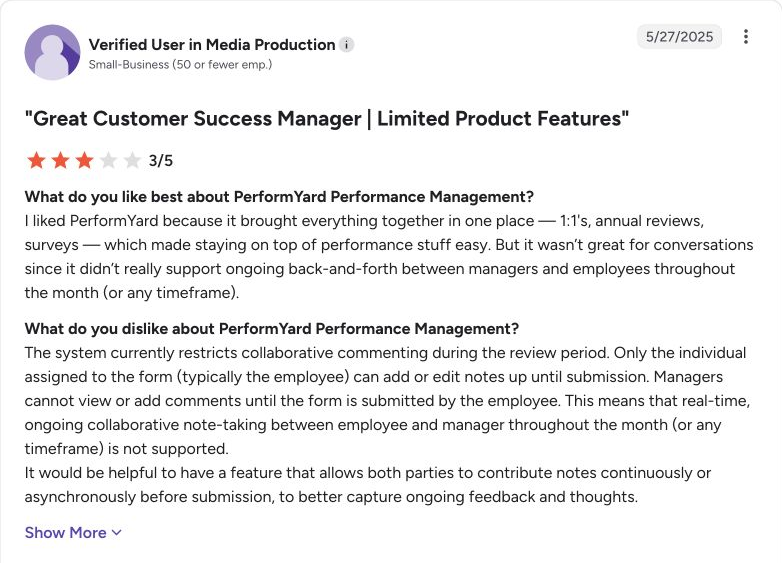
Source: G23/527 May 2025
Verified User in Media Production
Reviews were centralized, but pre-submission collaborative notes were missing.
Effect on our assessment: Adds a demo question about collaborative notes before submission; this individual experience is not a universal product fact.
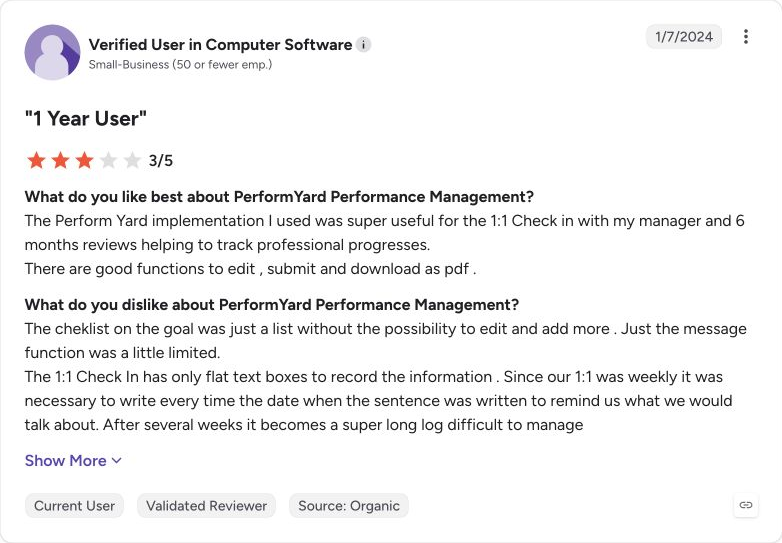
Source: G23/57 January 2024
Verified User in Computer Software
1:1s and check-ins were useful, but text-based logs felt flat and long.
Effect on our assessment: Tempers our assessment of manager follow-through and adds a demo question about log readability.
Santiago is a talented analyst with 5 years of experience specializing in talent acquisition and management software. He is passionate about understanding how HR tech impacts diversity and inclusion initiatives. His background in healthcare and hospice operations gives him deep empathy for employee wellness and cultural considerations in tech selection.
Akiko brings 6 years of expertise in enterprise HR systems and organizational transformation. She focuses on large-scale implementations and change management strategies. Her background in wealth management and corporate finance provides unique insights into how organizations optimize HR technology investments for long-term strategic value.
James is a rising talent in HR software analysis with 2 years of experience. He brings fresh perspectives on emerging technologies like AI and machine learning in HR platforms. His background in software engineering gives him technical credibility when evaluating platform capabilities and integration potential.